The Ted Knutson Question; Doing a Brentford; The Unofficial Partner List of Expensive Stories; Specificity
overthinking the sports business, for money
The Ted Knutson Question
I don’t know Ted Knutson personally. But his name is a signal of something.

Knutson appears in the ‘About’ section of Crux Football, the women’s multi club investment vehicle led by Bex Smith, this week’s guest on Other People’s Money, the UP finance series.
Hear here:
Knutson, or Knutson®, is listed as strategic director and an investor in Crux.
My head, like yours I’m sure, went to Brentford, and then to ‘the Brentford story’.
Certain nameless Twitter community members have complained endlessly about it (the StatsBomb brand) over the years. (Though not nearly as much as they complained about the term “Expected Goals.”) Sky Sports once told me that if there should ever be “an explosive event in the UK,” they would no longer be able to credit our company for visualisations on air, out of respect for the victims.
We can agree that the Knutson/StatsBomb approach at Brentford was genuinely transformative in men’s football.
The obvious question, which is central to the Crux investment thesis, is whether it be replicated in the women’s game?

Can Montpellier do a Brentford?
Doing a Brentford has become industry shorthand.
It is one of Unofficial Partner’s Expensive Stories, defined as narratives the investment community wants to hear when being pitched a new sports product?
I asked Jon Varney, CEO of Brentford, for his version of doing a Brentford here:
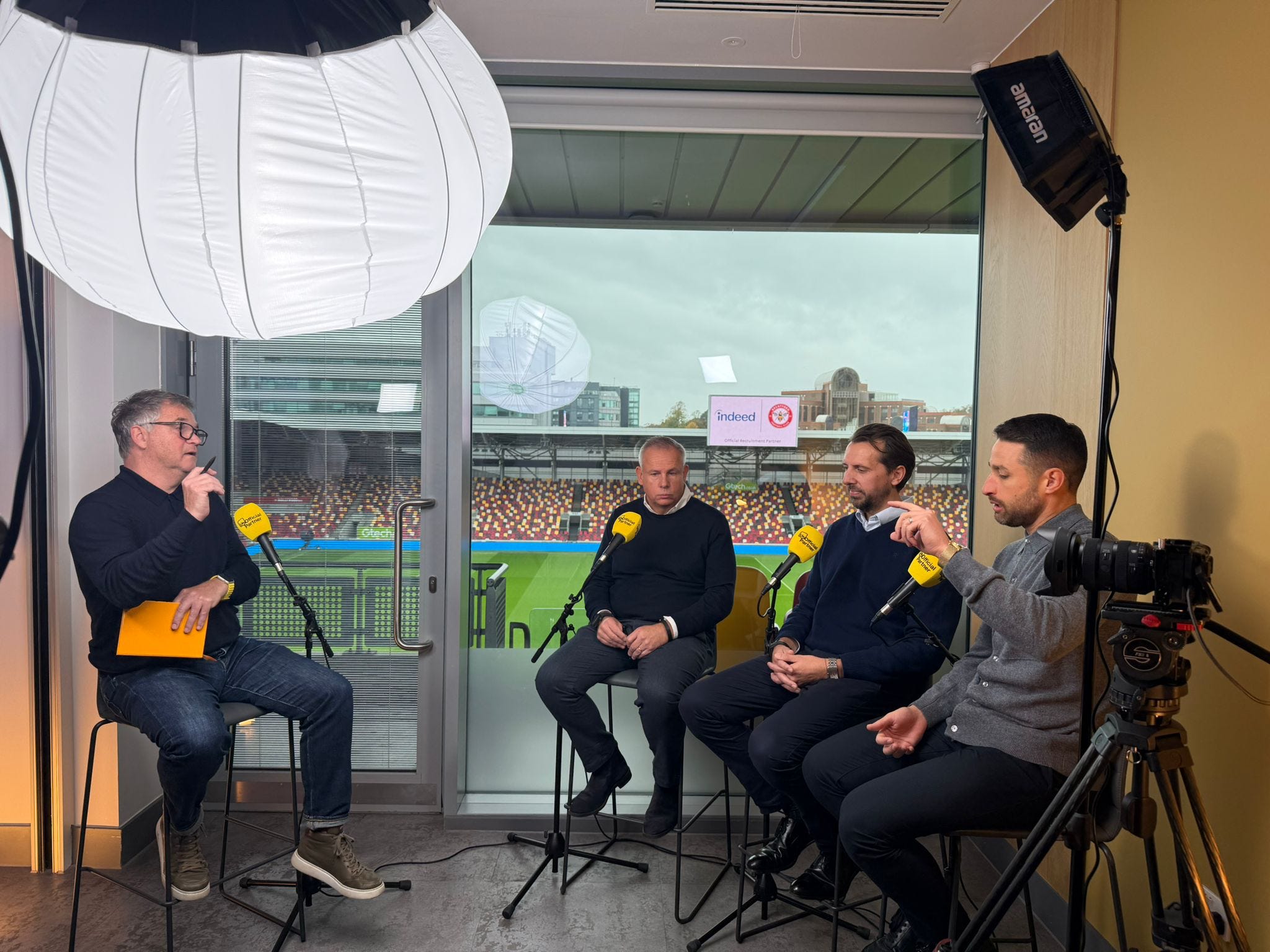
(The story is still working btw. Note this week’s story of new investors in to Brentford).
Then I asked Chat_UP, Unofficial Partner’s idiot savant AI language model, for five definitions:
1. Doing a Brentford (v.): Winning arguments in West London pubs with all the wit of a chartered accountant.
2. Doing a Brentford (v.): Buying a player nobody’s heard of for £3m, selling them for £30m, then explaining why it was mathematically inevitable.
3. Doing a Brentford (v.): Turning a professional gambler’s spreadsheet into a football club’s transfer policy and having it somehow work.
4. Doing a Brentford (v.): Outperforming clubs with fifty times your budget by treating football like it’s a market inefficiency waiting to be exploited.
5. Doing a Brentford (v.): Making “we have StatsBomb at home” an actual competitive advantage rather than a meme.
Anyway, you get the point.
Brentford had Knutson’s data, historical match records, and built an extensive analytical infrastructure to draw on. What does women’s football data look like in the Première Ligue and Damallsvenskan right now?
Are there StatsBomb-quality datasets for these leagues, or are they building the analytical model on much thinner foundations?
The Brentford model worked in the Championship partly because of market inefficiency; clubs weren’t using data properly, so Brentford could identify undervalued players systematically.
Is that inefficiency still present in European women’s football? Or are clubs increasingly analytical, reducing the edge?
If player trading is the primary value creation mechanism, and it implicitly has to be at clubs with minimal media rights income, how many player sales per year do you need across the portfolio to make the numbers work?
And what does a “good” sale look like in women’s football right now in France and Sweden in fee terms? All of this leads to the bigger question, which is whether there’s sufficient liquidity in the total transfer market to make doing a Brentford viable?
All of this is part of our conversation with Bex Smith. She was great btw, have a listen.
What Went Right?
I’ve come to think this is the hardest question in any sphere: What - specifically - went right?

So much of what we talk about follows this shape:
Success happens.
The reasons for the success are devoured for meaning.
These reasons become ‘lessons’, which calcify in to received wisdoms and become widely used proofs of concept.
And on we go.
The middle bit, number 2 above, is where the problem lies.
Our analysis of success is riddled with attribution error, giving credit to the wrong things, and/or over playing the impact on success on one single factor.
We do this because it’s easy.
My initial assumption, driven by a naive view of finance, was that the investment community wouldn’t fall for this trick, and that The Unofficial Partner List of Expensive Stories® wouldn’t apply to them, because they are as we all know, the smartest guys in the room.
Full disclosure: the more I learn about finance, the less I think they are the smartest guys in the room.
Stop saying Spotify for Sport
Music as tap water.
(From: The Death of Spotify: Why Streaming is Minutes Away From Being Obsolete).
Jimmy Iovine’s argument has obvious resonance for a sports biz audience: once labels lost format control, the tech companies turned music into a utility.
Identical libraries, zero differentiation, tap water economics.
Unlike video streaming, where exclusive content creates moats, music DSPs pay roughly 70% of revenue to rightsholders, killing margins.
Spotify is structurally screwed; Apple and Amazon can absorb losses because music sells iPhones and Prime subscriptions. A version of the ‘alternative bundle’ argument.
The escape route is direct ownership.
Artists building micro-communities through Discord servers, merch, vinyl and hard tickets (did I mention I’ve just bought a turntable? Having got an electric car I’m now looking at new areas of boring the shit out of people).
The music industry spent a decade obsessing over mass reach. The next decade belongs to 1,000 fans who care forever.
Turns out Kevin Kelly had a point. Who knew?

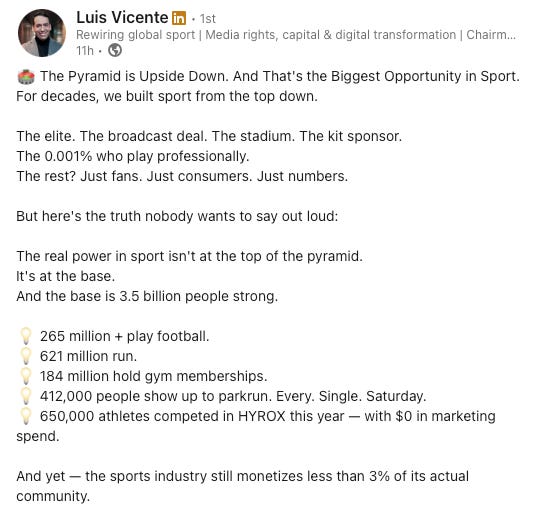
Jump to: Upside down pyramids
Matt
It’s been so touching to witness the outpouring of love for Matt Cutler this week.
Be sure to raise a glass in his name.